

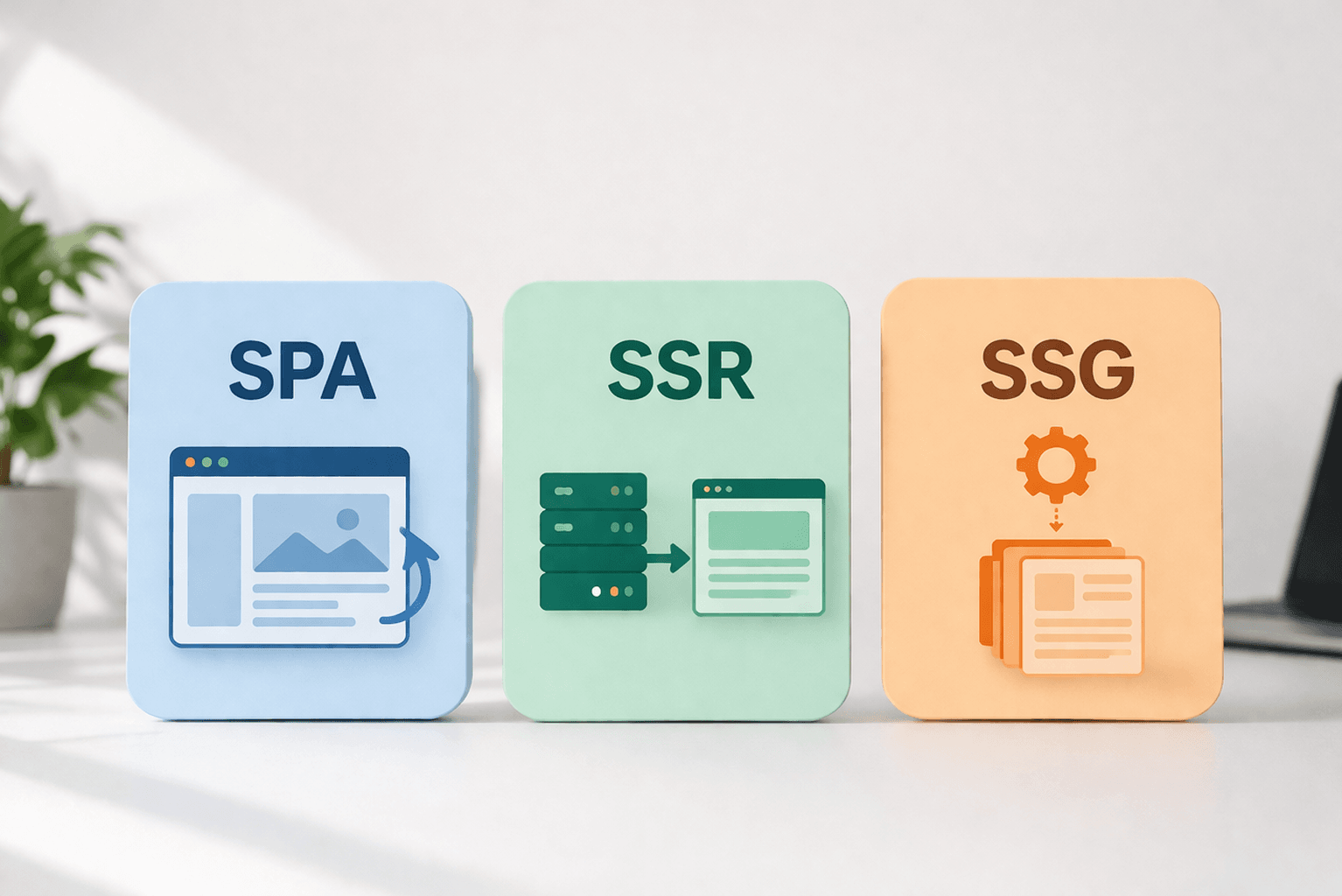
When building modern websites or web applications, you will often come across terms like SPA, SSR, and SSG. These are different rendering approaches that determine how your content is delivered to users and search engines. Choosing the right method is crucial because it directly affects performance, user experience, and SEO. In this guide, we will break down each approach in a clear and practical way.
First: What is SPA (Single Page Application)
A Single Page Application loads a single HTML page and dynamically updates the content using JavaScript without refreshing the page. Popular frameworks like React and Vue commonly use this approach.
The main advantage of SPA is a smooth and fast user experience after the initial load. It feels more like a mobile app, with seamless navigation and minimal interruptions. However, the downside is that the first load can be slower, and SEO can be challenging since search engines may have difficulty indexing content that relies heavily on JavaScript.
Second: What is SSR (Server-Side Rendering)
Server-Side Rendering means that the server generates the full HTML page on each request and sends it to the browser ready to display.
This approach significantly improves SEO because search engines receive fully rendered content immediately. It also enhances the initial loading performance, especially for users on slower devices or connections. On the downside, SSR increases the load on the server and may require more complex infrastructure to handle high traffic efficiently.
Third: What is SSG (Static Site Generation)
Static Site Generation builds all pages in advance during the build process, and the site is served as static files.
SSG offers excellent performance because static files are extremely fast to load and can be easily cached or delivered via CDNs. It is also very SEO-friendly since the content is pre-rendered. However, it is less suitable for applications with frequently changing content unless you implement frequent rebuilds or incremental updates.
Key Differences
The core difference lies in when and where the HTML is generated. In SPA, rendering happens in the browser. In SSR, it happens on the server at request time. In SSG, it happens ahead of time during the build process.
In terms of performance, SSG is typically the fastest, followed by SSR, while SPA may lag during the initial load. For SEO, SSR and SSG have a clear advantage over SPA. For interactivity and dynamic user experience, SPA stands out after the initial load.
When Should You Use Each One?
Use SPA when building highly interactive applications like dashboards or internal tools. Choose SSR when your site relies on dynamic content and requires strong SEO, such as e-commerce platforms or news websites. Use SSG for blogs, landing pages, and documentation sites where content doesn’t change frequently.
Conclusion
There is no one-size-fits-all solution when it comes to choosing between SPA, SSR, and SSG. Each approach has its strengths and trade-offs. Understanding these differences allows you to make better technical decisions and build faster, more efficient, and SEO-friendly web applications.