

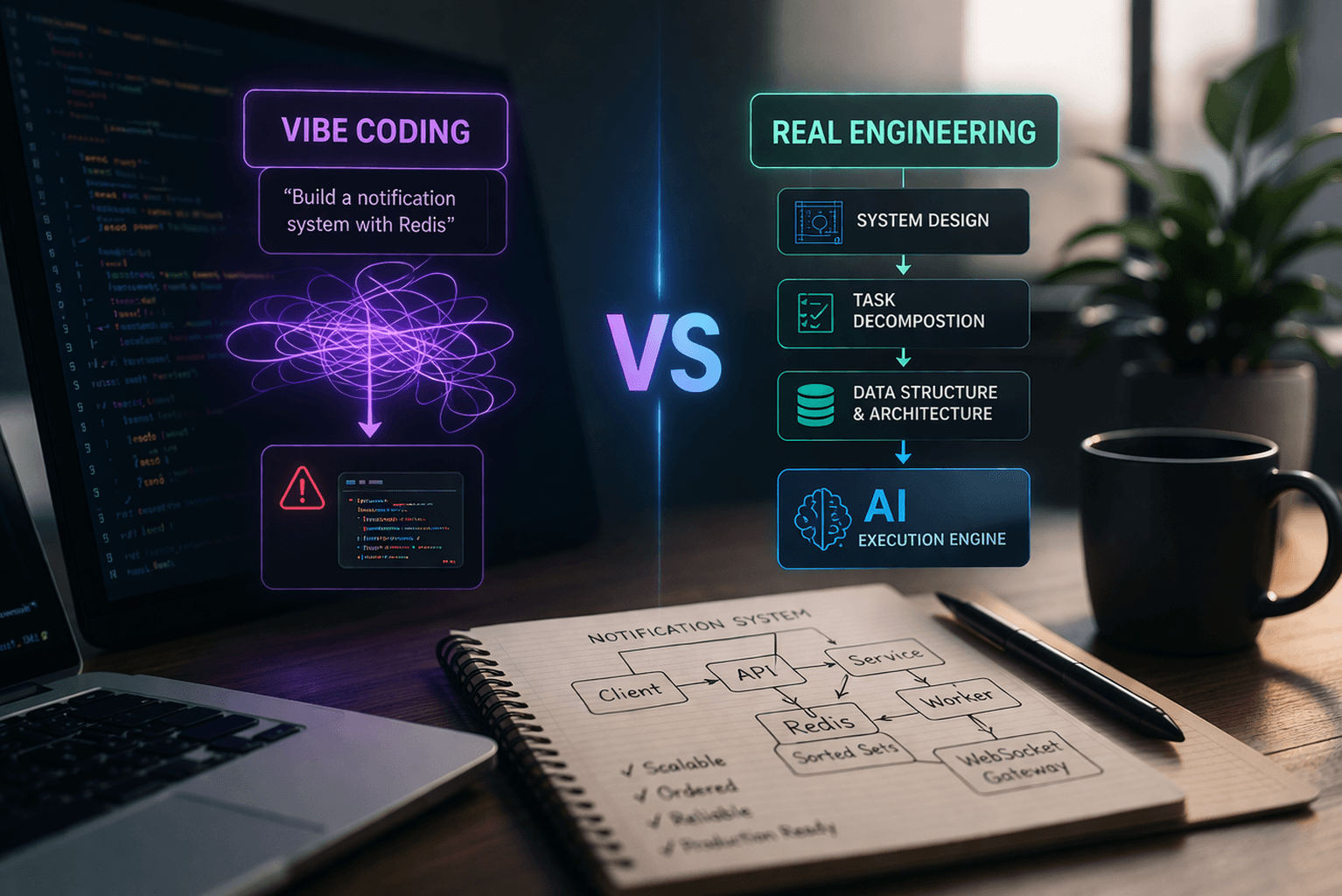
Recently, the term “Vibe Coding” has been spreading across the tech community, promoting the idea that building software is now as simple as writing a prompt and letting AI handle everything else. While this sounds appealing, it’s a misleading concept that oversimplifies software engineering and ignores its core principles: logical thinking, problem solving, and system design.
What Is Vibe Coding and Why Is It Misleading?
Vibe Coding is based on giving high-level instructions to AI and expecting it to build complete systems. This approach might work for simple prototypes, but it falls apart when applied to real-world applications.
AI has not yet reached the level of autonomous reasoning required to design and maintain complex systems independently. It is a powerful tool, but not a replacement for engineering thinking. Relying on it blindly often results in code that works on the surface but fails under real conditions.
The Role of a Real Software Engineer
The true value of a software engineer goes beyond writing code. It lies in understanding system internals and designing scalable architectures.
A strong engineer is able to:
Create clear system designs before implementation
Break down problems into manageable tasks (task decomposition)
Choose the right data structures
Anticipate bottlenecks before they occur
In this context, AI becomes an execution engine that accelerates development, not a substitute for expertise.
How to Use AI the Right Way in Development
The smart way to use AI is to guide it with your own understanding, not rely on it blindly.
You can leverage AI for:
Writing boilerplate code
Speeding up repetitive tasks
Optimizing code snippets
Generating specific components based on your design
However, the logic, architecture, and decision-making must remain in your hands.
Real-World Example: Notifications System with Redis
Imagine you are building a real-time notifications system using Redis.
With Vibe Coding, you might give a vague prompt like:
“Build a notification system using Redis.”
The result might work perfectly in a local environment. But once deployed to production and traffic increases, issues start to appear:
Race conditions between concurrent requests
Memory leaks
Server crashes
Poor connection pooling handling
No backpressure control
These issues happen because the internal system design was never properly considered.
The Difference Between Vibe Coding and Real Engineering
A real software engineer approaches the same problem differently:
Defines a clear system architecture
Selects appropriate data structures (e.g., Sorted Sets in Redis for ordered notifications)
Plans for concurrency and scalability
Breaks the system into well-defined tasks
Then uses AI to implement specific parts like optimized queries or helper classes based on a predefined design.
The Risks of Vibe Coding
Relying on Vibe Coding without proper engineering knowledge can lead to serious issues:
Unmaintainable code
Poor performance at scale
High technical debt
Difficult debugging
Loss of system control
These problems often result in costly refactoring and wasted development time.
Why Engineering Thinking Still Matters
AI is a powerful assistant, but it does not fully understand the broader system context like a human engineer. Critical thinking and problem solving remain essential for building reliable software.
The stronger your fundamentals, the better you can leverage AI to produce high-quality results.
Conclusion
Vibe Coding is not a magic solution—it’s an oversimplified approach wrapped in modern marketing. The real advantage comes when you act as the architect, fully understanding your system and using AI as a productivity booster, not a replacement.